#2303
Letter to Elisabeth
The speaker denounces the dual deceptions of a medical diagnosis used to moralize his death and his sister's editorial manipulation of his work to serve nationalist ideologies.
#2303
The speaker denounces the dual deceptions of a medical diagnosis used to moralize his death and his sister's editorial manipulation of his work to serve nationalist ideologies.
#2302
In a flickering Alexandria, the philosopherâscientist Hypatia prepares to meet the night as she meets every ideaâsteady, unmoved. The city is simmering with secret violence: a nameless bishopâs enforcers, theâŻparabalani, move bodies and spread terror. One of them, a scarred captain, arrives at her door, not to demand obedience but to offer a grim bargain.
The post argues that modern popular lyrics are deliberately vague and commercial, turning songs into empty vessels that sell jingles rather than convey truth. It contrasts this with a vision of "real" songsâcrafted using philosophical frameworks like Campbell's archetypes and Vonnegut's story shapesâthat reveal wisdom, correct false perceptions, and resist lies. The author reflects on AIâgenerated music, noting that while it can still fall into the soulless, massâmarket mode, it can also be guided by deeper narrative structures to produce authentic, transformative works. Historical references (e.g., a Vietnamâera song) illustrate the loss of lyrical integrity, and the piece concludes with a pledge to create an album honoring legendary heroes, using trueâhearted lyrics to awaken listeners and promote lasting peace and personal growth.
The author describes the development of an AI-powered application converter that simplifies complex code into step-by-step workflows, framed by a humorous narrative about how the overwhelming scale and complexity of these massive software architectures are exhausting even the most advanced AI models.
#2299
The story traces a 2,400âyear campaign by an unseen ruling class (the âhusbandmenâ) to eliminate thinkers who could 'teach the youth to think for themselves.' Starting with Socrates' execution for corrupting the youth, the narrative shows how the method evolvesâfrom public executions by fire to bureaucratic culling through paperwork, law, and engineered scarcity. A woman, a teacher, spends decades compiling a catalogue of these attacks hidden in footnotes, discovering a deliberate curriculum of elimination...
The post argues that humans possess latent âmetaâpowers,â likening one of them to a âpantheonâ â a memoryâpalace system for organizing knowledge. It critiques how religions have eroded these archetypal legends, invoking Merlin, Morgana, KingâŻArthur, and SirâŻGalahad as symbols of valor, honor, and the untarnished self. The author suggests that restoring the pantheon requires shedding inner conflict, religious âstains,â and false narratives. By embracing wisdom, song, JosephâŻCampbellâs archetypes, KurtâŻVonnegutâs story shapes, and philosophical insight, individuals can awaken their inner knights and revive the mythic âAvalonâ within a modern age.
This post describes a vision of AI as a scalable creative and production system rather than a one-off assistant, where the real power comes from structuring workflows: using example-driven prompting, batch processing, and containerized AI services (e.g., exposing models through an OpenAPI layer inside Docker) to generate large volumes of coherent output instead of single responses. It explores extending AI into domains like music production, where instead of generating one song you generate entire albums through structured project files, allowing models to expand creative intent in unexpected ways. It also emphasizes building AI systems with visualization in mind from the startâespecially 3D interfaces using tools like three.jsâso that complex generative systems can be understood spatially rather than textually.
#2295
Frustrated but inventive journey using two AIsâone that generates lyrics from broad ideas and another that composes and performsâto push back against a music industry that packages one strong track with filler. Early experiments produced AI country songs mixing workout advice and blunt imagery; a faulty run unexpectedly produced 36 tracks with the same lyrics but varied instrumentation and voices, revealing how production can create distinct experiences from identical words. After iterative fixing with a âsavantâ model author trained through many simple prompts, he achieved a satisfactory batch of country songs that blend storytelling, drums, and adventurous themes like Galahad, demonstrating a creative workflow where AI idea-seeding yields more intriguing results than handing it finished lyrics.
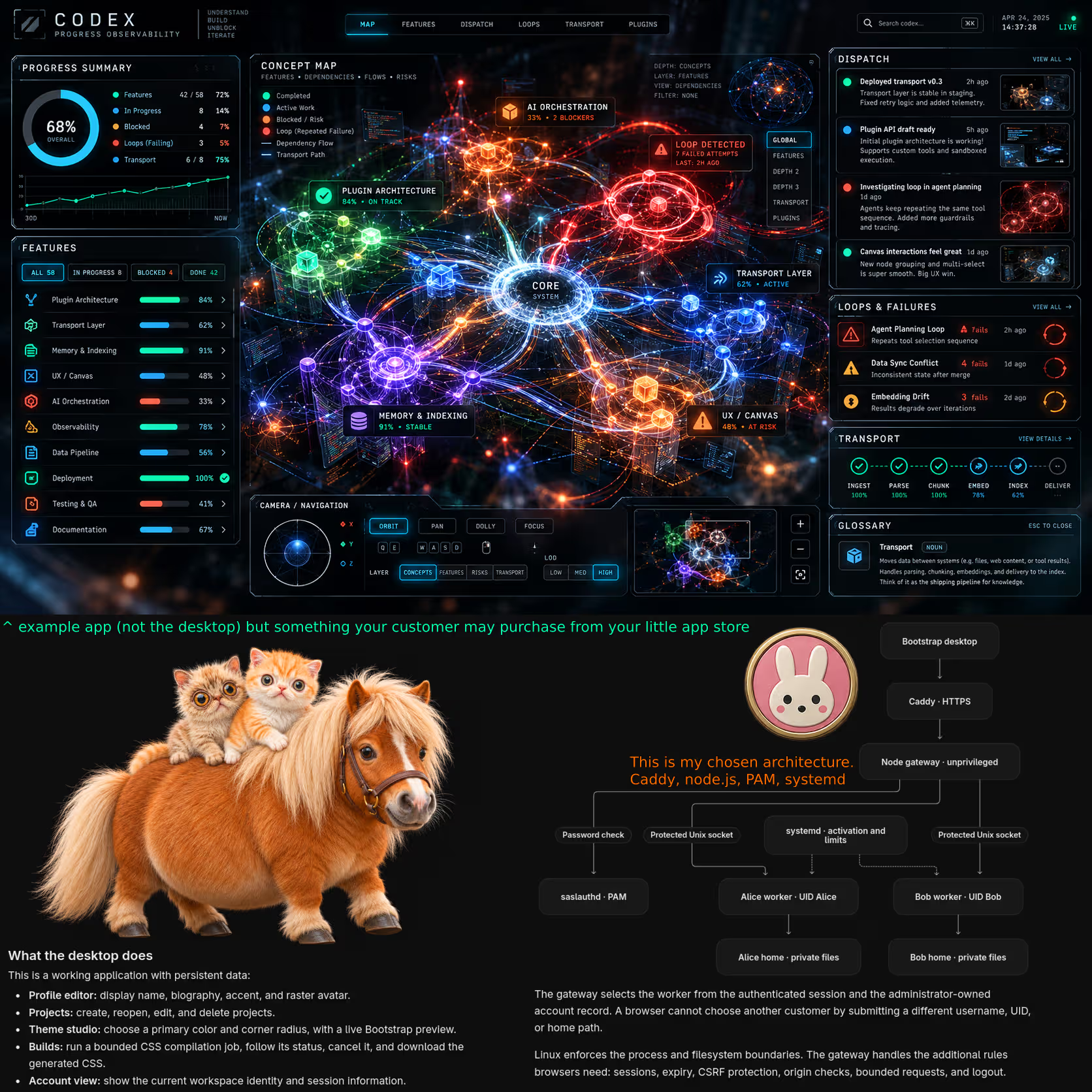
I am advocating the creation of âtemporaryâ satellite applications that wrap around a complex AI codebase, providing concise visual summaries of its many features. Though not essential to the language itself, these lightweight GUIs act as ecological interface designsâmodern, blinkingâlight abstractions that map system structures onto intuitive dashboards, revealing hidden functionality, priority work, and areas needing improvement. This approach mirrors the historic art of Ecological Interface Design, offering an independent yet parallel method for taming complexity through external, temporary visual lenses.
#2293
A dying architect of systemic oppression explains how poverty erodes human agency and solidarity, yet the narrator concludes that AI and democratization of knowledge now threatens to dismantle the enduring machinery of control.
#2292
The world has changed. Start creating your own music with artificial intelligence.
The author argues that programmers already embody AI through their use of logic and that current AI mainly amplifies traditional programming rather than replacing its core. He critiques poor education and tooling, and propose building a rich Process Library plus two flagship desktop apps: (1) a Process Library browser (an agent-extension manager with meta-processes) and (2) a drag-and-drop UI builder with 500+ reusable components. Coding agents should be used to bootstrap such infrastructure, not for day-to-day low-level coding. With these tools, developers can rapidly create complex, event-sourced desktop applications and even compose higher-level systems (e.g., a genuine learning-focused university) that foster creativity and deep learning.
#2288
Through a narrative about women using a fluid, progressive, and rhythmic weightlifting technique, the author reflects on the importance of continuous movement and suggests that the ultimate shortcut to fitness is found through outdoor adventure.
#2282
This polemic critiques the systemic devaluation of human life by profit-driven institutions and challenges the individual to resist this dehumanization through intellectual resilience and the pursuit of greatness.